
Get it wrong, and you're looking at inconsistent tolerances, surprise rework bills, and a supply chain that feels like a liability instead of an asset. Get it right, and that partner starts operating like an extension of your own engineering team.
The stakes are measurable. FMA's 2023 benchmarking survey of U.S. fabricators found an average on-time delivery rate of just 84%, with scrap and rework eating up 1.4% of sales, up from 1.0% the year before, according to The Fabricator's analysis of the survey. That's real money and real missed deadlines, even among established shops.
This checklist walks through exactly what separates a dependable fabrication partner from a risky vendor bet.
Key Takeaways
- Weigh capabilities, quality systems, engineering support, and logistics, not just price
- Certifications like ISO 9001 and documented QC steps reduce defect rates and compliance risk
- In-house design and nesting support cuts material waste and prevents costly redesigns
- Full-service providers like Victory Manufacturing Services combine fabrication, welding, and construction under one roof
What Is a Metal Fabrication Partner?
A metal fabrication partner is different from a one-off vendor. Instead of just filling job orders, they collaborate with you across design, production, and delivery, catching problems before they become expensive.
This might mean weighing in during the CAD phase, flagging a bend radius that will cause tooling issues, or adjusting a nesting layout to squeeze more parts out of a single sheet. A transactional vendor cuts what you send; a partner asks the right questions before the job hits the shop floor.
Fabrication partners typically specialize by process or material:
- Sheet metal shops focused on cutting, bending, and forming thin-gauge material
- Structural steel fabricators handling beams, columns, and heavy assemblies
- Pipe and tube specialists serving process industries
- Multi-material fabricators who work across carbon steel, stainless, and aluminum in a single shop
Knowing which type matches your project is the first filter before you even start comparing checklists.
Core Components of a Metal Fabrication Partnership
Three functional areas separate a real partnership from a transactional order: design collaboration, production processes, and finishing/logistics. Each one adds or removes friction from your project.
Design & Engineering Collaboration
CAD drafting and nesting software aren't just back-office tools. They're where waste gets designed out before a single cut happens.
Design for Manufacturability (DFM) input, when a shop actually applies it, means someone reviews bend geometry, tooling requirements, and feature placement before production starts. Skip this step, and you find out about a manufacturability problem after the parts are already cut.
Nesting software has a documented, measurable payoff too. Common-line cutting techniques, where parts share cut lines on a sheet, can reduce cutting time by up to 40%, according to Hypertherm's nesting analysis published in The Fabricator. That's a direct efficiency gain that shows up in your invoice.

Fabrication & Production Processes
This is where equipment and welding capability determine whether your parts come out consistent or come back for rework.
Look for shops running:
- CNC plasma or laser cutting for repeatable precision on complex profiles
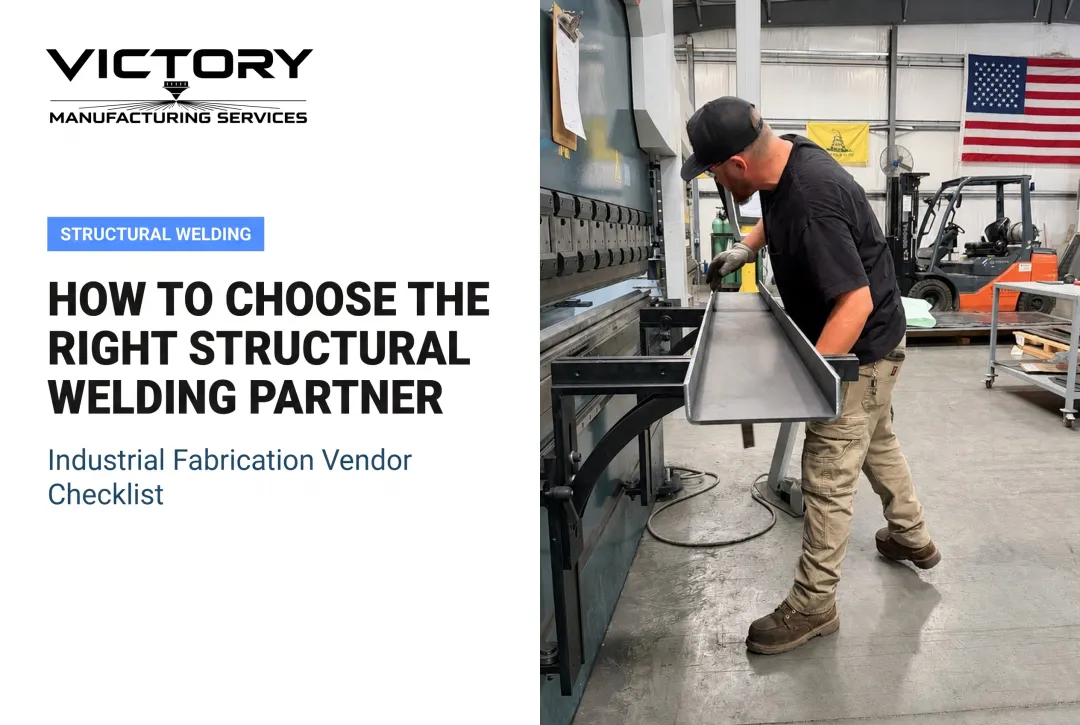
- Forming and bending equipment (press brakes) capable of handling your material thickness and part geometry
- Multi-process welding (TIG/GTAW, MIG/GMAW, Flux Core/FCAW, and Stick/SMAW) so the shop selects the right method for the material and application, rather than forcing every job through one process
A shop limited to one welding process or one cutting method often ends up subcontracting the rest, and every subcontracted step adds a handoff and a chance for something to slip through the cracks.
Finishing, Delivery & Logistics
A perfectly fabricated part that arrives damaged or three weeks late is still a failure. Finishing and logistics capability determines whether the last mile of your project goes smoothly.
Key questions to ask:
- Does the shop offer in-house coating or painting, or do parts leave the building unfinished?
- What packaging standards protect parts during transit?
- Can the shop ship nationwide, or only within a limited radius?
A shop that finishes and packages in-house avoids another vendor handoff, and another opportunity for something to go wrong between fabrication and your dock.
Benefits of Working with a Fabrication Partner
Moving from a transactional vendor to a true partner delivers outcomes you can actually measure:
- Shorter lead times, since design issues get caught before production instead of during a rework cycle
- Fewer quality escapes, thanks to consistent process control and material handling
- Lower total supply chain risk, because working with a single full-service partner (fabrication, construction, and maintenance under one roof) means fewer vendors and fewer points of failure
- Easier scaling, moving from a single prototype to full production volume without switching suppliers mid-project
- Better cost predictability, as a partner who understands your parts can quote more accurately than a vendor seeing your drawing for the first time
The payoff shows up in fewer emergency phone calls and fewer line items labeled "unplanned."
What to Consider When Choosing a Metal Fabrication Partner
Fabrication needs look different depending on your industry. A construction contractor's priorities aren't the same as an OEM running high-mix, low-volume production. Weigh the following factors against your own priorities, not a generic best-practices list.
Each one below translates into a measurable outcome, whether that's on-time delivery rate, defect frequency, or total project cost.

Fabrication Capabilities & Equipment Range
A partner should own a broad equipment set — shears, brakes, CNC plasma cutters, tube benders — so you're not forced to juggle multiple vendors for one project.
This range also determines scalability. A shop that can move a design from a single prototype to a full production run without re-tooling or outsourcing saves you time and reduces coordination overhead.
Material Expertise & Compatibility
Proficiency across carbon steel, stainless steel, and aluminum means a partner can support diverse project specs without farming out material work to a third shop.
Material mismatch isn't a small issue. Using the wrong alloy, or a shop with limited experience in a given material, directly affects part durability and long-term field performance. Ask specifically what materials a shop routinely works with, not just what they claim to be 'capable of.'
Quality Certifications & QC Processes
Certifications signal a documented, auditable quality system rather than a shop's word alone. Here's how the major ones break down:
| Certification | What It Covers |
|---|---|
| ISO 9001 | Organization-wide quality management system, sector-neutral (ISO 9001:2015) |
| AWS Certified Welding Fabricator | Facility-level welding accreditation covering personnel, procedures, and equipment |
| AISC Certification | Structural steel fabrication and erection quality systems |
| Material Test Reports (MTRs) | Documented traceability of material chemical and physical properties |
A shop with first-article inspection protocols and MTR documentation catches problems before an entire production run is affected, not after. This reduces rework frequency and compliance risk, especially in regulated industries.
Engineering & Design Support
In-house CAD drafting and DFM support catch design flaws while they're still cheap to fix. Once a part is in production, the cost of a redesign multiplies fast.
This factor shows up in your numbers as material waste percentage and overall project cost efficiency. A shop with no engineering input just executes whatever you send them, flaws included.
Turnaround Time, Location & Logistics
Proximity matters more than people expect, especially for time-sensitive industrial repairs. A shop that offers mobile welding and clear production scheduling can shave real time off unplanned downtime.
This factor shapes your on-time delivery (OTD) rate and total logistics cost. Ask any prospective partner for their actual OTD track record, not just a promised turnaround window.
Pricing Transparency, Reviews & Track Record
Clear, itemized pricing, broken into labor rates, material, and outside processing, prevents scope creep before it starts. Shop rates are typically built from direct labor, fixed and variable overhead, and material costs, according to The Fabricator's estimating guide.
Verifiable references and past project outcomes matter just as much as the number on the quote. A low bid with no track record is a bigger risk than a slightly higher bid backed by proof.
How Victory Manufacturing Services Can Help
Victory Manufacturing Services operates as a full-service fabrication and industrial construction partner based in Winchester, Virginia, serving clients across Virginia, Maryland, and West Virginia, with nationwide shipping for fabricated parts.
What sets this model apart from single-process fabricators is straightforward: you don't need three vendors to complete one project.
Victory's capabilities cover the checklist above in a single shop:
- Multi-process welding (TIG, MIG, Flux Core, and Stick) selected to match the material and application at hand
- CNC plasma cutting with DXF, SVG, and vector file compatibility for precise, repeatable cuts
- CAD drafting and nesting software to optimize material usage and reduce waste before production starts
- Advanced forming equipment, including a 165-ton Pacific brake press and a 150-ton CNC Durma precision brake, for consistent bending across production runs
- On-site mobile welding, bringing full welding capability directly to a customer's location to cut downtime on time-sensitive repairs
- Prototype-to-production scalability, supporting everything from R&D prototypes to ongoing production part orders
Combine that with an in-house air spray paint booth for finishing and nationwide shipping for fabricated components, and Victory ends up handling nearly every step in-house, cutting the coordination work off your plate.

For projects requiring rigging, millwright work, or structural steel erection alongside fabrication, that same single-provider model applies.
Conclusion
This checklist is designed to help you find the fabricator whose capabilities, certifications, and processes match your production priorities, rather than simply the most well-known name in your region.
Run any prospective partner through the same lens: capabilities and equipment, material expertise, quality systems, engineering support, logistics, and pricing transparency. Skip a category, and you're accepting risk you didn't need to take on.
This also isn't a decision you make once and forget. As your production volume, materials, or timelines shift, revisit whether your current partner still fits. Performance, capacity, and pricing all change over time, and your evaluation should too.
Frequently Asked Questions
How much do metal fabricators charge per hour?
Hourly rates vary based on process complexity, material type, and region, with shop rates typically reflecting direct labor, overhead, and material costs. Request an itemized quote from each prospective partner for an accurate comparison.
What do you call someone who does metal fabrication?
The formal occupational title is "structural metal fabricator and fitter," though professionals often use "fabricator" and "welder/fabricator" interchangeably. The role covers cutting, welding, forming, and fitting metal components to specification.
What certifications should a metal fabrication partner have?
ISO 9001 covers general quality management systems, while AWS Certified Welding Fabricator and AISC certifications address welding-facility and structural steel-specific quality controls. The right certification depends on your industry and regulatory requirements.
What's the difference between a metal fabricator and a metal fabrication partner?
A fabricator fills job orders as a transactional vendor. A fabrication partner engages earlier, offering CAD drafting, DFM input, and prototyping support, then sticks around for ongoing production and maintenance needs.
How do I know if a fabricator can handle both prototypes and production runs?
Look for in-house CAD drafting, nesting software, and equipment capable of both single-unit and repeatable high-volume work, like CNC cutting and precision brake forming. A shop offering dedicated R&D and prototype services is a strong signal.
Should I choose a local or national metal fabrication company?
Local providers offer faster turnaround and on-site services like mobile welding, which matter for time-sensitive repairs. National providers may offer more scale, but a regional partner with nationwide shipping, like Victory, often covers both needs.